

Most of us start exercising to look better or lose weight. Very few people realize that the biggest transformation isn’t happening in the mirror – it’s happening inside the skull.
Over the last few years, neuroscience research has caught up with what physiotherapists have long observed in clinic: movement doesn’t just rebuild muscle and joints, it rebuilds the brain. As a physiotherapist who has spent over 14 years helping patients recover strength and mobility, I’ve seen firsthand how patients who stay physically active often report sharper focus, better sleep, and a calmer mind – alongside their physical recovery. So let’s look at what’s actually happening when you commit to a regular routine, and why the connection between exercise and brain health is stronger than most people assume.
1. New Brain Cells Are Literally Being Formed
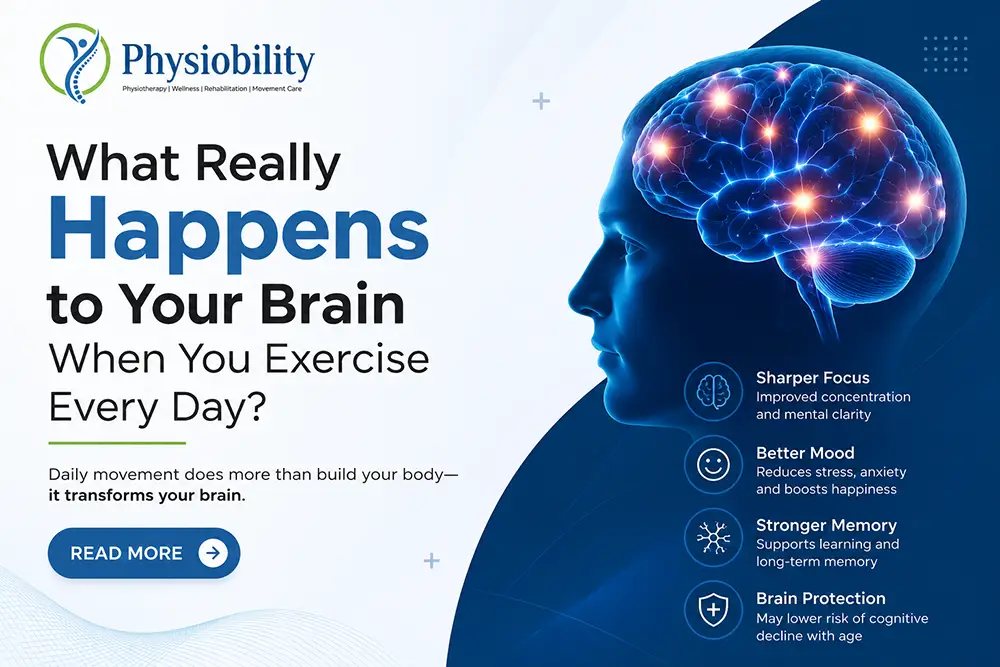
When you exercise, your body increases production of a protein called brain-derived neurotrophic factor (BDNF). Recent expert reviews describe BDNF as one of the key drivers behind exercise-induced brain plasticity – it supports the growth of new neurons and strengthens connections between existing ones, particularly in areas tied to memory and motor control. This is one of the most well-documented benefits of exercise for the brain, and it applies at almost any age, not just to the young.
2. Blood Flow to the Brain Improves
Every time you walk briskly, cycle, or swim, your heart pumps more oxygen-rich blood throughout the body – including to the brain. Research published in 2025 on aerobic training in older adults found consistent improvements in cerebral blood flow, vascular function, and neuronal connectivity, even among people who started exercising later in life. Better blood flow means better delivery of oxygen and nutrients to brain tissue, which supports clearer thinking and slower age-related decline.
3. Your “Happy Chemicals” Get a Natural Boost
Exercise triggers the release of dopamine, serotonin, and endorphins – the same neurotransmitters targeted by many mood-regulating medications, but produced naturally by your own body. A 2025 review in Frontiers in Human Neuroscience highlighted that even vigorous activity performed a few times a week was linked to meaningfully reduced anxiety levels, while very light or sedentary activity showed little to no effect. In short: intensity matters, and consistency matters even more.
4. Memory Gets a Real, Measurable Upgrade
Your hippocampus – the brain’s memory center – responds directly to physical activity. Multiple 2025–2026 studies, including work published in Brain Structure & Function, have linked higher cardiorespiratory fitness to stronger neural network connectivity, with researchers now actively studying how exercise may lower levels of proteins associated with Alzheimer’s risk. Separately, short aerobic interventions in older adults have shown measurable improvements in verbal and visual memory in as little as four weeks.
5. Stress and Anxiety Come Down a Notch
Exercise helps regulate the amygdala – the brain’s alarm system for fear and stress. A widely cited 2025 analysis covering 57 studies found that older adults who exercised regularly showed significant cognitive improvements, especially in focus, mental flexibility, and the ability to filter out distractions – all functions closely tied to lower baseline stress. Clinicians note that many people notice a mood lift within the same day of a session, well before any long-term physical changes appear.
6. Immunity Gets Stronger Too
It’s not just your brain – regular movement also supports a more resilient immune system, which is one reason patients recovering from illness or surgery are encouraged to reintroduce safe, guided movement as early as appropriate. Better sleep quality, itself improved by exercise, plays a supporting role here as well, since deep sleep is when the brain’s own waste-clearance system is most active.
What the Latest Research Really Confirms
A large 2025 study following over 75,000 adults, published in Nature Aging, found that people who packed their physical activity into just one or two days a week (“weekend warriors”) saw brain-health benefits comparable to those who exercised throughout the week – including a reduced risk of dementia, stroke, anxiety, and depression. The takeaway for busy professionals: some structured activity is far better than none, even if a daily routine isn’t always realistic.
Practical Tips to Get These Brain Benefits
- Start small and stay consistent. A 10-minute walk three times a week is a realistic starting point; build up gradually rather than overtraining early and burning out.
- Mix aerobic and strength work. Walking, cycling, or swimming support blood flow and memory; resistance training supports different but complementary brain regions.
- Protect your sleep. Exercise improves sleep quality, and sleep is when your brain clears out metabolic waste – the two work together.
- Choose activities you’ll repeat. Yoga, Zumba, badminton, or an outdoor sport you enjoy will always beat a “perfect” routine you abandon in two weeks.
- Move around screen time, not through it. Replacing passive scrolling with even short activity bursts adds up across a week.
Among the wider daily exercise benefits, brain health may be the one that pays off the longest – supporting sharper focus today and a lower risk of cognitive decline decades from now.
When Pain or Injury Is Holding You Back
For many people, the biggest barrier to staying active isn’t motivation – it’s pain, an old injury, or uncertainty about which movements are safe. That’s precisely where a structured, professionally guided rehabilitation plan makes the difference between guessing and progressing safely.
At Physiobility, we work with patients recovering from orthopedic injuries, post-surgical conditions, and chronic pain to help them rebuild strength and mobility – so that staying active isn’t just possible, but sustainable for the long term.
Resources:
- https://www.sciencedirect.com/science/article/abs/pii/S0166223624000626
- https://pmc.ncbi.nlm.nih.gov/articles/PMC12788999/
- https://news.vumc.org/2025/10/07/vumc-neuropsychologist-shares-why-regular-exercise-benefits-the-brain-physically-and-mentally/
- https://www.medscape.com/viewarticle/fascinating-phenomenon-your-brain-exercise-2026a1000bqz
- https://www.ncbi.nlm.nih.gov/pmc/articles/PMC12748147/
- https://medresearch.umich.edu/research-news/brain-health-benefits-exercise
- https://www.ncbi.nlm.nih.gov/pmc/articles/PMC12085549/
- https://www.cdc.gov/physical-activity/features/boost-brain-health.html
- https://content.health.harvard.edu/blog/regular-exercise-improves-brain-regions-linked-with-memory